HARMONY - August 2012
Wed, 1st Aug 2012
Category : Harmony, News (All)
Special Feature: Q & A
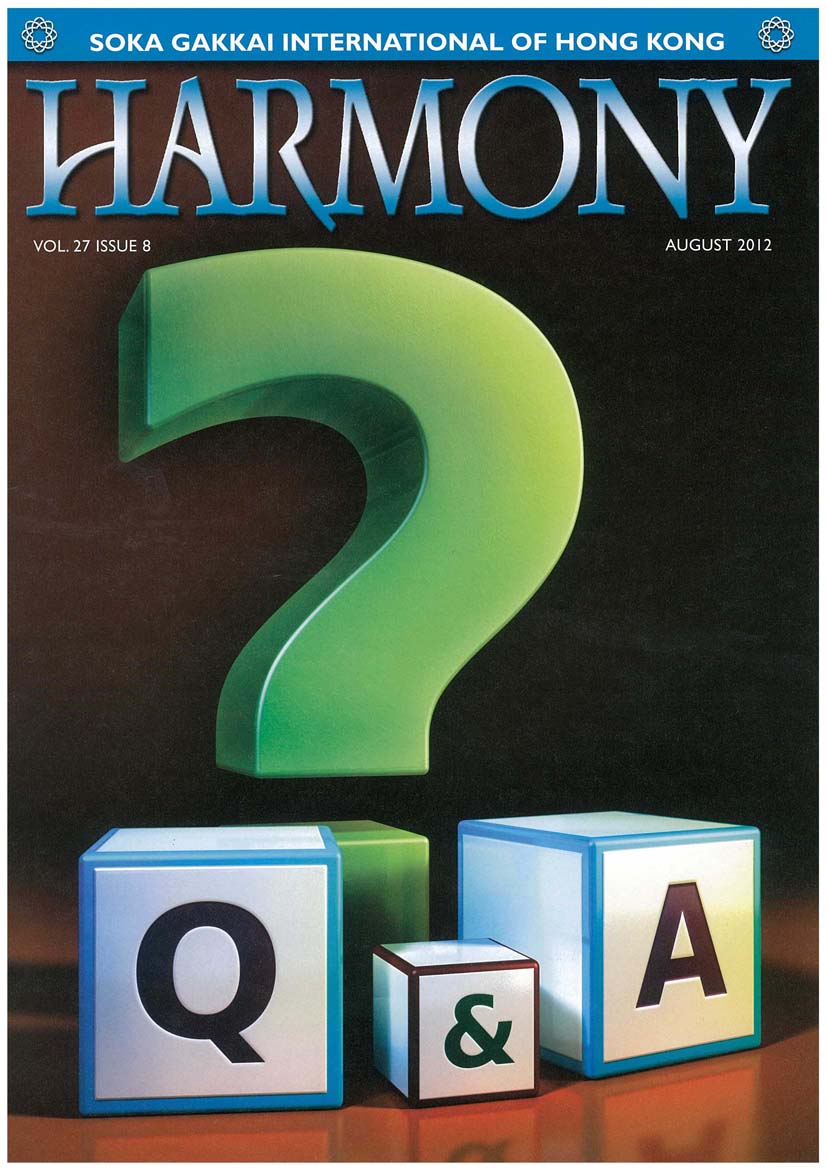
As always, we thank you for picking up this month’s issue of Harmony.
The purpose and mission of Harmony, and all SGI publications, is to provide study material, experiences and encouragement to assist in our practice of Nichiren Buddhism.
Whether you are a new member, have been chanting for many years, or have just been exposed to the benefits of Nam-myoho-renge-kyo, questions will naturally arise. And they should. As practitioners of Nichiren Buddhism, we are encouraged to raise questions, thus deepening our understanding and faith in this practice.
As Francis Bacon said:
“Who questions much, shall learn much, and retain much.”
Asking questions is a sign of a seeking spirit, and a seeking spirit and study are essential on the path to enlightenment. Our chanting needs to be supported by study and thus a deeper understanding of our practice, so that we do not stumble and succumb to obstacles that come our way.
In fact, almost all Buddhist scriptures consist of questions asked by a listener and the Buddha’s sermons are given as answers to them. Thus, the sutra itself takes the form of a question-and-answer meeting.
Many of the letters that Nichiren wrote were in the format of answers to questions that his followers had or he anticipated they would ask.
President Toda conducted many question-and-answer meetings, thus helping the members deepen their faith.
Faith in Nichiren Buddhism is not blind faith. It is a faith that develops through actual proof and by actively searching for answers to the many questions we may have.
Buddhism is a vast topic, and we can only ever touch on a small part of the many questions that will arise. We sincerely hope that this Q&A issue of Harmony will shed light on some of the questions that you might have about this wonderful philosophy, and that it will help you to develop and seek out more answers.
skip Williams
Quote of the month
“Human beings are inherently endowed with the power to bring out the best possible result from the worst possible circumstances.” (www.ikedaquote.org)
Available at all HKSGI Culture Centres
HARMONY - July 2012
Wed, 11th Jul 2012
Category : Harmony, News (All)
Special Feature: Illusions, Attachments & Desires

When we follow the daily practice of Nichiren Daishonin’s Buddhism, we recite excerpts of the Lotus Sutra morning and evening (Gongyo) and chant Nam- myoho-renge-kyo to the Gohonzon.
As Richard Causton says on page 1 of the introduction to his book The Buddha in Daily Life:
“If you do this, study and teach others the Buddhist view of life to the best of your ability, you will develop a state of life in which your desires are completely fulfilled, which creates the maximum value and good fortune for yourself and your society, and which is powered by unshakeable happiness and confidence, no matter what problems you may be facing”.
That’s a mighty statement, and in this issue of Harmony we go deeper to explore how we can utilize our illusions, attachments and desires to create a life that is rich in value and free from suffering.
The most challenging part of our Buddhist practice is not just developing a regular rhythm in our daily practice, but also learning to “master our mind”. We must look at ourselves and re- examine our fundamental thinking and beliefs, which in turn drive us to actions that can hinder us from progressing on our path of realizing true happiness.
In reality, problems are not the problem. Our fears and the perceived or real inability to overcome them is the source of our suffering. But of course, when in the middle of a struggle to solve a problem, this is extremely difficult to realize, and we can be defeated by our circumstances, even though Nichiren Daishonin mentions it again and again in letters to his disciples. This is why we need to chant and study.
Our Buddhist practice and study enables us to clear our mind and see how all situations are really opportunities to learn and progress, to deepen our faith and develop a strong self and happiness from within. One that is un-swayed by circumstances and the environment. Rather than being a slave to our desires, we can chant and transform those yearnings to wisdom.
We sincerely wish that this issue of Harmony gives you some eye-opening insights on how to transform your life and to shine brilliantly and be absolutely happy.
Carola Chard
Quote of the month
“People’s desires are limitless. There is the basic desire to live. There is also the instinctual desire for food, the materialistic desire for possessions, and the psychological desire to be noticed. We could not live with desires. Often, desires generate the energy that enables us to move forward and improve ourselves. The key question, therefore, is how we use desires.” (www.ikedaquote.org)
Available at all HKSGI Culture Centres
HARMONY - June 2012
Wed, 6th Jun 2012
Category : Harmony, News (All)
Special Feature: Time to Start Winning The Peace
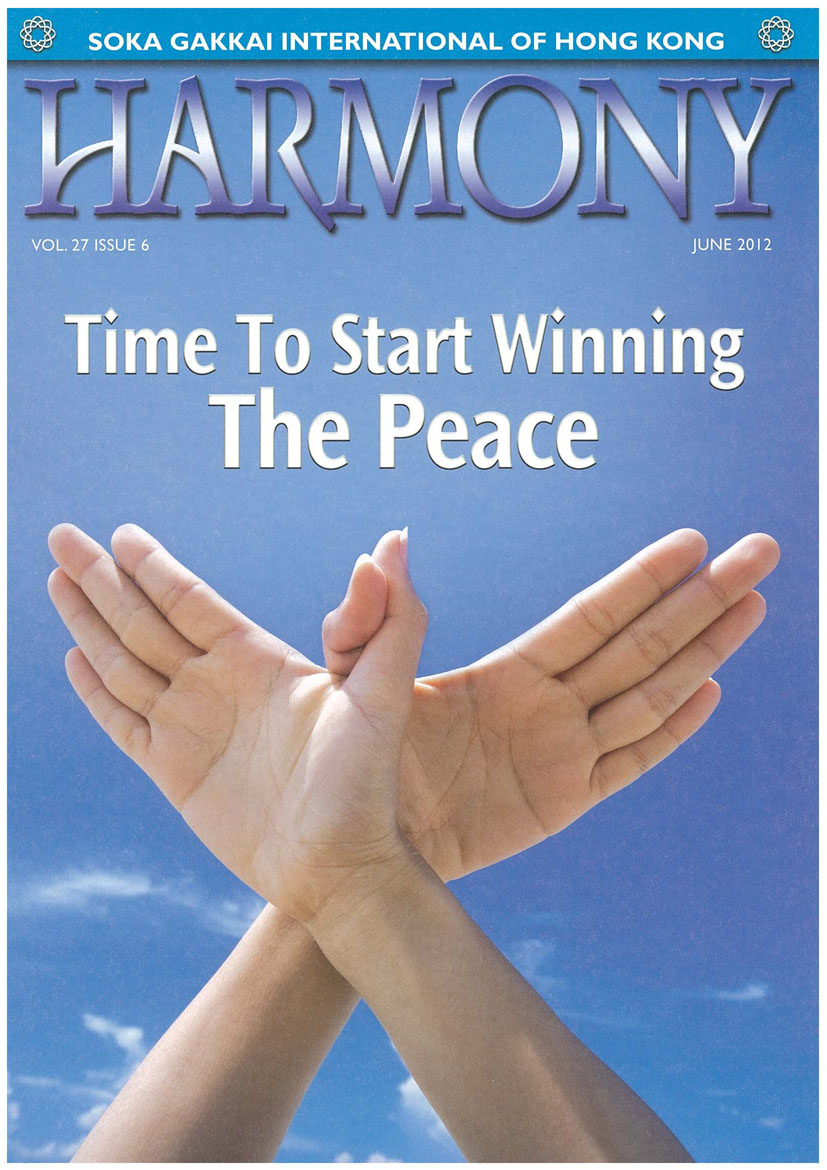
This month we look at Peace, what it means and how we can contribute.
There are many different types of peace. Peace within the individual, in the family, at work, in the neighborhood, all the way to a global peace.
Pick up any newspaper or watch the news and you will read or see many reports about the various acts of violence perpetrated on one another, be it war, terrorism, or crime. Constant bombardment like this certainly contributes to the feeling of hopelessness and one of futility.
As our cover suggests, peace is in our hands. It is something that is up to us to make, to shape, to create.
The desire for peace is a natural one. It is important for each of us to understand that we, as an individual, can make a difference.
Peace will never happen unless there is a fundament shift in the way mankind thinks. As the population continues to increase, it will be harder and harder to achieve real peace unless there is a drastic shift in the way we view ourselves, each other and our inter-connectedness.
As Albert Einstein said.
“The world we have created is a product of our thinking; it cannot be changed without changing our thinking.”?
Peace is not achieved through legislation; it starts with each of us. An inner-transformation on a personal level, our human revolution, is needed to overcome the negative tendencies of greed, anger and foolishness that are the root cause of today’s problems.
In his 1995 Peace Proposal, President Ikeda states:
“In Mahayana Buddhism, which is the creed of Soka Gakkai, there are ten potential conditions of life inherent in a human being, known as the ten worlds. According to this principle, people who start wars exist in the four lowest states of Hell, Hunger, Animality, and Anger, known together as the “four evil paths.” Controlled directly by instinct and desire, their thoughts and actions are inevitably foolish and barbaric. Therefore, from the Buddhist point of view, the issue of how to build the “defenses of peace” within the hearts of such individuals takes precedence over any external systemic factors, and represents both the well-spring and the core of any attempt to build world peace. “
As President Ikeda has said:
“A great human revolution in just a single individual will help achieve a change in the destiny of a nation and, further, will enable a change in the destiny of all humankind.”
Let’s start winning the peace.
Robert “Skip” Williams
Editor-in-chief
Quote of the month
“Peace is not found somewhere far away. Peace is found where there is caring. Peace is found when you bring joy to your mother instead of suffering. Peace is found when you reach out and make an effort to understand and embrace someone who is different from you.” (www.ikedaquote.org)
Available at all HKSGI Culture Centres
HARMONY - May 2012
Mon, 30th Apr 2012
Category : Harmony, News (All), Publication
Special Feature: Buddhist Parenting
In this month’s Harmony, we look at some of the challenges of parenting from the perspective of faith.
We have a natural desire to want to be good parents, to nurture our children as they grow. Promoting and supporting the physical, emotional, social and intellectual development of a child, from infancy to adulthood, can be very challenging at times. Parents are on a steep learning curve the moment the baby arrives, as they don’t come with an instruction manual.
Young parents often get advice and opinions from a lot of people; doctors, nurses, their own parents, relatives and friends, all advising them on what they should do. A quick Internet search on “parenting” gives an overwhelming 288,000,000 results, with many differing thoughts as to how to raise “successful” children. Putting the child first and balancing the needs of the child with one’s own is a constant juggling act, especially for a single parent.
As Buddhism teaches, each of us operates with the best intentions, but we act within the boundaries of our own and our family karma. We have the tendencies to copy and repeat what we learned from our own parents. This is why a strong Buddhist practice is crucial for parents, enabling them to change their karma and give the child a solid foundation based on the wisdom developed through their chanting.
As you will read in our special features, one of roles of a parent is that of being a child’s first teacher. Children are keen observers and will do as you do, not as you say. The lessons of right and wrong, compassion and conviction, individuality and unity, as well as gratitude and respect, are learned by copying the parents and are key for developing capable children. A parent’s unconditional love and care is also a crucial factor for the child to develop a healthy self-image and confidence.
President Ikeda has written on the importance of parenting and has a keen insight on raising children to become capable people. His advice is founded in the Buddhist principals of reason, compassion and love, for each individual and all humanity.
As President Ikeda says:
“All children are gems, full of precious potential. There is hope in every child since life itself is full of hope. Should the hopes of children be stifled or broken, that would be our responsibility as adults. It pains my heart to see what goes on in today’s society. I do not want to see the eyes of children darkened with fear and clouded with tears of sorrow. Society must be absolutely transformed. Children are mirrors that reflect adult society. When adults are ailing and their vision clouded, children will also suffer. Let us wipe away the tears of sorrow from the face of each child! We must protect children and give them courage, strength and vitality. It is parents who nurture children, the hope of humanity. How noble parents are! What a great mission and responsibility they fulfill.” (Buddhism Day By Day, p.174)
Robert “Skip” Williams
Editor-in-chief
Available at all HKSGI Culture Centres
HARMONY - Apr 2012
Wed, 28th Mar 2012
Category : Harmony, Publication
Special Feature: Women of Strength
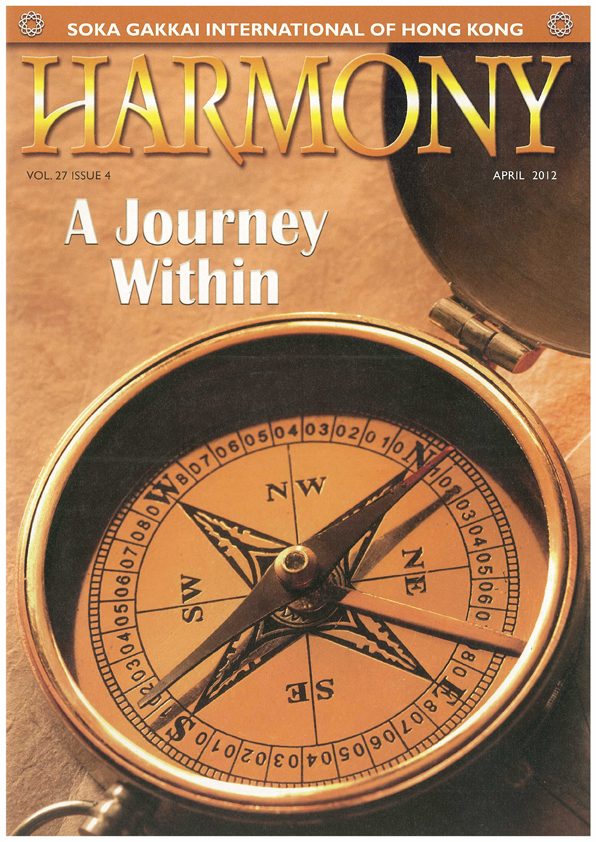
It is very simple, just chant Nam-myoho-renge-kyo. Simple, yet very profound. Chanting enriches our life and by doing so we become truly happy.
With that spirit in mind, this month’s theme is “A Journey Within”. As you will read in the special feature and viewpoints, the foundation to a happy life lies within us. No external deity is worshiped in Nichiren Buddhism nor do we seek salvation from our sufferings outside of ourselves.
What we adhere to is the realization that each and every person on the planet, without exception, has an enlightened life-condition, the Buddha nature, just waiting to manifest from within.
Revealing the Buddha within is something that only we can do for ourselves, it cannot be delegated. Other people can’t do it for us, not our family or friends. We change our karma, no one else. We alone manifest our Buddhahood, right where we are, right now.
There is no magical place we need to visit to change it all. Nor do we need priests, monks or nuns to pray on our behalf, their prayers have no special powers. There are no intermediaries between believers and the power and teachings of Nichiren Buddhism. We are all the same. Each person chanting has the same ability to achieve the highest life-state of Buddhahood.
Nichiren Daishonin makes it clear that much of our suffering and unhappiness results from the futile search for happiness outside ourselves.
This concept is extremely prevalent in today’s consumer driven, quick fix society. All to often we feel that happiness can be found in the external. “If only I had (insert name of your favorite possession) I would be happy. I’m not now, but if and when I get it, then I will be.” Or, “if only I had more money, or looked a certain way, then I would be truly happy for the rest of my life.” And when we don’t get what we think we need, we become miserable and suffer.
Nichiren made it very clear that what matters most is our faith. And our faith is not enhanced or deepened by something or someone for us. Faith and happiness comes from within. True happiness is unshakeable and independent from any external event. This is the true challenge – seeing everything we face in daily life as an opportunity to grow and deepen our faith so we can be happy, no matter what.
Our journey toward genuine happiness is an inward journey, one based on our own faith. Bon Voyage!
Robert “Skip” Williams
Editor-in-chief
Available at all HKSGI Culture Centres
HARMONY - Mar 2012
Tue, 6th Mar 2012
Category : Harmony, News (All), Publication
Special Feature: Women of Strength

I have no idea who first claimed that women were the “weaker sex” but obviously he never met anyone from the Women’s Division of the Soka Gakkai.
I’m not sure why, maybe it is insecurity, maybe arrogance, but past events have shown that men have a tendency to under estimate the ability of women.
Even in these modern times, in many parts of the world there exists large disparities and inequity. Women are thought to be less then men, second-class citizens, and sometimes livestock is even revered more than a mother, daughter or sister.
But this is not about comparing men to women, or who is better. It is about acknowledging, respecting and appreciating the special role that women play in all of our lives: from birth to raising us, from the home front to the world stage, and how they do things differently than men. Perhaps it is because they are coming more from a level of compassion than ego.
From a Buddhist standpoint, there is no difference between the sexes. One is not superior to the other. All people, men or women, equally possess the Buddha nature, the ability to achieve enlightenment, just as there are. All people are equal and worthy of the upmost respect.
Please read our special features for more insight into the strength that women have, and what powers it.
Also, this month we celebrate March 16th, the day that, in 1958, the youth division were entrusted with the noble mission of striving for world peace and tenaciously working for the happiness of all people.
We hope that you will enjoy this issue of Harmony and celebrate kosen-rufu day with a great victory in your life.
Robert “Skip” Williams
Editor-in-chief
Available at all HKSGI Culture Centres
Quote of the month
“March 16, Kosen-rufu Day. The spirit of this day lies not in magnificent ceremonies or high-sounding words. It lies in being victorious. That is the most crucial thing in all endeavors. In life and in kosen-rufu, we either win or lose. I would like you to be absolute victors in both. No matter what excuses we try to make, giving in to defeat brings misery and loses us the respect of others. I hope each of you without exception will adorn your life with indestructible triumph.” (Daisaku Ikeda, For Today and Tomorrow)
HARMONY - Feb 2012
Mon, 30th Jan 2012
Category : Harmony, News (All), Publication
Special Feature: Sharing the Happiness
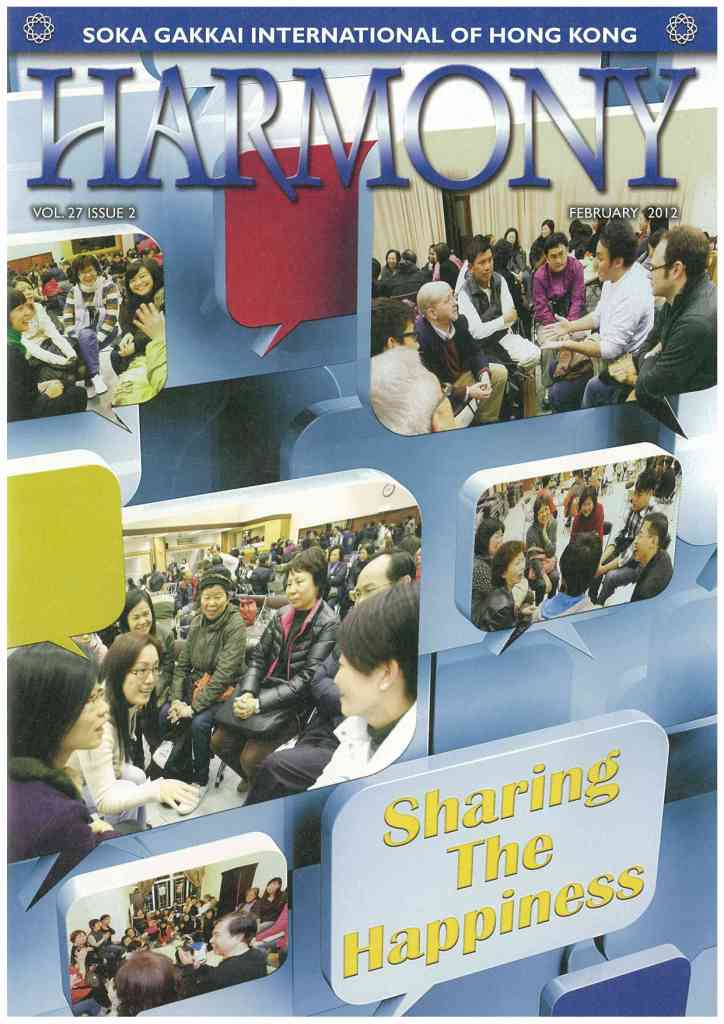
This month we look at the way we can help people become absolutely happy and overcome any suffering or negative situation they might be experiencing.
Let’s face it, the world today is a difficult and challenging place. The headlines are full of people and nations doing unspeakable things to each other. The respect and care for another person’s dignity and life seems to stop with ones immediately family and sometimes it doesn’t even extend that far.
Anywhere you turn, you can find people who are at a loss as to how to fundamentally change their circumstances, let alone positively impact the lives of others.
It seems that people are all to often ruled by greed, anger or foolishness. But they don’t have to be.
As Nichiren Buddhists, we know that the key to be able to transform our lives, the lives of our family and friends and the people around us, lies in the heart of the Lotus Sutra, chanting Nam-myoho-renge-kyo.
When we chant we tap into our inherent Buddhahood, and as a result we manifest our hope, courage and confidence. We realize that we can definitely change any situation. Unless we share this transformative ability with others, they will never know that they also have the key within to change any situation and possess the ability to be absolutely happy.
As President Ikeda says:
“Each person possesses a precious inner treasure of infinite worth. To remain unaware of this and stumble about in spiritual poverty is a tragic waste. In contrast, a person fully awakened to the jewel-like dignity of their own life is capable of truly respecting that treasure in others.”
If we are to change the direction of the world from its current situation, we must help others awaken to the inherent value of not only their own life but the lives of others.
Let’s share the happiness of chanting Nam-myoho-renge-kyo with others.
Robert “Skip” Williams
Editor-in-chief
Available at all HKSGI Culture Centres
HARMONY - Jan 2012
Sat, 31st Dec 2011
Category : Harmony, News (All)
Special Feature: Creating Hope

One of the greatest benefits of chanting Nam-myoho-renge-kyo is that, quite naturally, a sense of hope is created within us. ?Regardless of the circumstances, with a strong Buddhist practice, anyone and everyone can be triumphant. ?This is a natural result of chanting. We are challenging and overcoming our fundamental darkness and opening the door that allows our inherent Buddhahood to shine forth.
When we lack hope, we allow our negativity to take hold. We question ourselves, our worth; we succumb to the situations around us, and can feel that there is no way out or that no better future lies ahead.
But as President Ikeda reminds us, “A life filled with hope is strong. Hope is the greatest weapon in the world.”?(DOY p. x)
As is discussed in our special features, hope is something that we create; it is something that comes from within us, not from outside ourselves.? Sure, we all respond to our external environment, but to seek hope just from the outside is setting us up for disappointment. Especially when we are constantly bombarded by news reports that seem to focus only on negative events or the dark side of humanity.
So again the question becomes, how do we create hope, especially when things look so bleak? How do we find and open that door, revealing the beauty and wonder that awaits us on the other side? Simple, we chant.
“Whether in suffering or in joy, even in the face of an insurmountable deadlock, if one continues to chant daimoku (Nam-myoho-renge-kyo) wholeheartedly, then tremendous hope will naturally well up from within.” (Daily Guidance vol. 2 p. 352).
Hope is optimism.?
“There is no pessimism in Buddhism-not in the past, present or future. There is only optimism.? Therefore, let us advance eternally with hope and optimism, come what may.” (FIA p. 127)
Nichiren Daishonin teaches us how to live our life to the fullest and reminds us that courage and perseverance are essential qualities to attain happiness. Let’s create hope and encourage others as we move along this path.
Robert “Skip” Williams
Editor-in-chief
Available at all HKSGI Culture Centres
HARMONY - Dec 2011
Thu, 1st Dec 2011
Category : Harmony, News (All), Publication
Special Feature: The Difference Between Buddhism And Positive Thinking
Dear members and friends of SGI,
As always, we would like to thank you for reading this month’s Harmony.
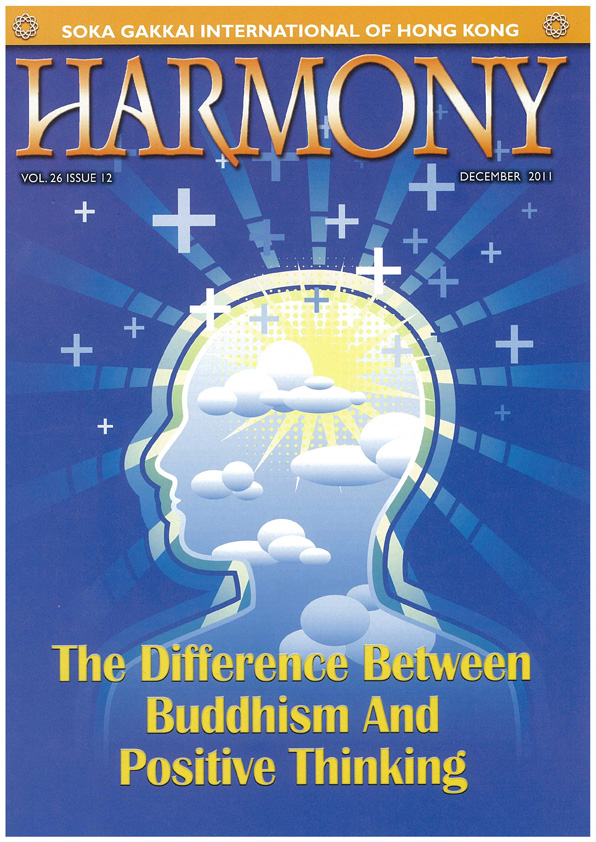
In this issue we take a look at the difference between Buddhism and positive thinking.
My father was a strong believer in the power of positive thinking and the power of a positive mind. Throughout my childhood I was bombarded with the slogans and sayings of his favorite motivational speakers. Until the day he died, he would always respond with an enthusiastic “GREAT” when anyone asked him how he was - regardless of how he was actually feeling.
My father was a voracious reader and our house was filled with all types of self-help books. One of the first books I can remember him giving me (beside Dr. Seuss) was “Think and Grow Rich” by Napoleon Hill and “How to Win Friend & Influence People” by Dale Carnegie.
I grew up on the stuff and I have seen first hand the power of such a thought process. Positive thinking has a lot of value and can add benefit to one’s life. My father was a very determined man who grew up very poor and was able to better his life and that of his family by holding such views.
But he was also a man who suffered a lot and was at a loss how to change himself, not just superficially but fundamentally. His positive thinking was a kind of band-aid, a way to cover up the wounds but never getting at the core problem. He was not able to change his karma through his positive mental attitude, regardless of how often he said “GREAT!”.
That is, of course, until he started to chant.
As is explained in our Special Features, Buddhism goes beyond just positive thinking and offers a means to change ones life at the core.
I feel grateful for having been exposed to a lot of the modern-day pioneers in the area of positive thinking. Having read books by many of them, I can honestly say that I find the very best inspirational speaker of our day to be Daisaku Ikeda. Whether a practicing Buddhist or not, his words touch one’s heart and offer hope to anyone willing to listen.
He teaches us how to use our Buddhist practice, not merely to change our attitude, but to understand and change our lives. Thus providing us with the never give up spirit than enables us to be happy and really win. Now that’s GREAT!
Robert “Skip” Williams
Editor-in-chief
Available at all HKSGI Culture Centres
HARMONY - Nov 2011
Tue, 1st Nov 2011
Category : Harmony, News (All), Publication
Special Feature: Beauty, Gain & Good
Dear members and friends of SGI,
Each November we celebrate the founding of the Soka Gakkai.
In honor of the occasion, this month our Special Features will look at Mr. Makiguchi’s perspective on creating value. It is important for us, as an organization promoting peace, culture and education, to examine our roots.
On November 18th, 1930, two years after embracing Nichiren Daishonin’s Buddhism, Tsunesaburo Makiguchi, together with his disciple and fellow teacher Josei Toda, published the first volume of The System of Value-Creating Pedagogy. It is from this date that we recognize the establishment of our organization.
When I first learned that educators had formed the Soka Gakkai, I was unsure as to the correlation or how this came about. After all, we are lay believers of Nichiren Daishonin’s Buddhism, not teachers, professors or academics, not most of us anyway. So what was the connection, that through education we lay the foundation for future life experiences and behavior?
As President Ikeda explains:
“Mr. Makiguchi found that Nichiren Daishonin’s Buddhism recognizes and seeks to develop the wisdom inherent in all human being. It correlated with his personal views on education and thus he considered it a philosophy of popular education. Mr. Makiguchi felt that in Buddhism he had found the means by which to realize the ideals he had pursued throughout his life–a movement for social reform through education.”
With the happiness and wellbeing of humanity at the core, Mr. Makiguchi & Mr. Toda worked tirelessly to lay a solid foundation for the firm establishment of the Soka Gakkai. They had the courage to stand up for their beliefs, even in the face of sever persecution, including imprisonment. It is because of this conviction that the Soka Gakkai exists today.
Under the leadership of our current president, Daisaku Ikeda, our organization has expanded to 192 counties and territories along with the establishment of the Soka Education System.
We hope that in this issue you will gain a greater understanding of how and why a pair of educators came about to establish what is now a dynamic organization that gives hope to people the world over.
Robert “Skip” Williams
editor-in-chief
Available at all HKSGI Culture Centres